Choosing Electronic Tint Smart Glasses is not simply a matter of selecting the darkest lens. The right pair should match your eyes, commute, work setting, and comfort expectations. In practice, bright sidewalks, reflective water, and dim offices expose weaknesses that showroom lighting hides. A useful evaluation begins with tint response, optical clarity, battery behavior, and frame fit. These details affect whether the glasses remain helpful after several hours.
Reliable products should explain how the lenses change shade, how quickly they respond, and what happens when power runs low. Look for independent test data, clear warranty terms, and manufacturer specifications rather than impressive promises. UV protection should be documented, not assumed from a darker appearance. If prescription lenses are needed, confirm compatibility with a qualified optical professional. Small nose pads can leave marks. Heavier frames may slide during walking. These issues are easy to overlook.
This guide examines lens technology, control methods, battery life, durability, privacy considerations, and everyday value. It also compares automatic sensors with manual controls, because convenience is not universal. Some users prefer gradual transitions, while others need predictable shade changes near windows or outdoors. Personal testing matters. A technically advanced pair may still feel distracting, fragile, or awkward. No single model fits every face. Marketing language can mislead. Checking return policies and testing comfort under real lighting support a more reliable purchase decision.
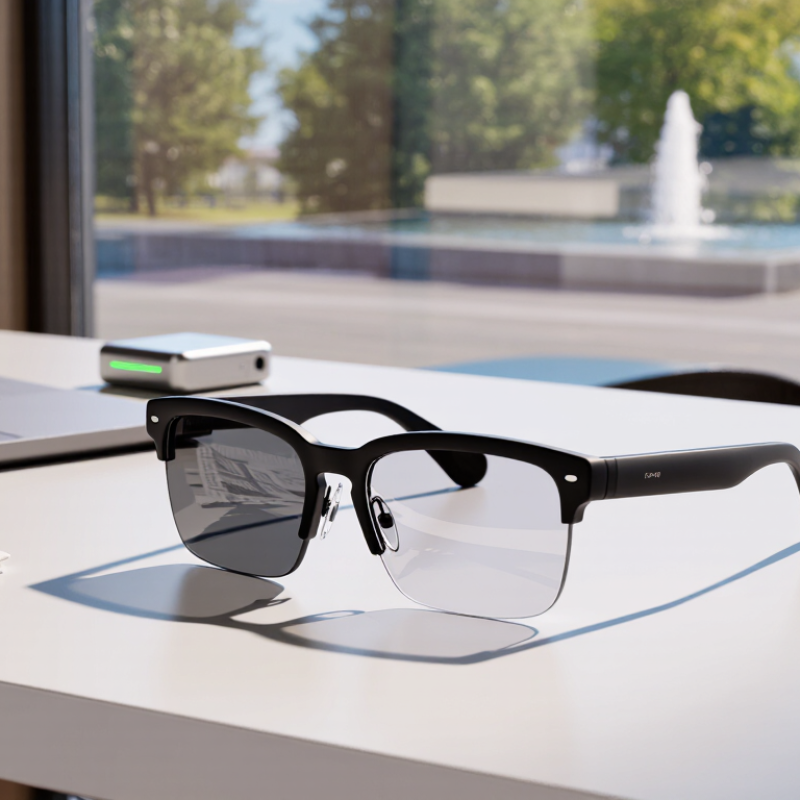
Choosing electronic tint smart glasses starts with your intended use, not the frame style. Consider where you will wear them most often. Indoor offices need a clear lens with gentle transitions. Outdoor driving, cycling, or hiking may require stronger glare control. A darker lens is not automatically better.
Think about viewing conditions throughout the day. Direct sunlight, reflected water, snow, and bright screens create different visual demands. Check the lens response time, visible light transmission, and control method. Automatic sensors can react smoothly, but nearby shadows may confuse them. Manual controls offer precision, although they can distract you when moving.
I once focused too much on maximum darkness. That choice felt impressive outdoors but seemed dull indoors. I should have tested the glasses during a full day, including cloudy weather and evening travel. Try them with your prescription needs, if applicable, and inspect whether the tint remains even across the lens. Ask for verified UV protection data; tint color alone proves little. Comfort also matters, because frequent adjustments can become irritating. Let actual lighting guide the decision.
Electronic tint smart glasses use different control methods, and each affects daily vision. Electrochromic lenses change tint through a controlled electrochemical reaction. They usually consume little power after reaching the selected shade. Their transition can take several seconds, especially in cold conditions. Suspended-particle devices switch faster and can provide a wide clear-to-dark range. However, they may require continuous power to stay transparent. Liquid-crystal systems respond quickly, but their dark state can look milky rather than truly shaded.
Optical performance deserves more attention than switching speed alone. Check visible light transmission in both clear and dark modes. A useful lens should preserve natural colors and limit distracting haze. Look for measured UV protection, glare reduction, and edge-to-edge uniformity. A bright window test helps. Compare the lens with a white page and a colored object. If white appears blue or gray, color neutrality may be weak. Polarization can improve glare control, but it may also make some digital screens difficult to read.
I would test the glasses outdoors, indoors, and inside a vehicle before buying. Ask for independent test data, not only product claims. Confirm the response time at different temperatures. Battery behavior also matters during long wear. Some lenses perform well in a showroom but feel too dark under office lighting. No method wins every test. Personal comfort can outweigh laboratory numbers, and that is easy to underestimate.
Choosing electronic tint smart glasses starts with fit, not futuristic features. The Vision Council’s 2024 Consumer Insights report indicates that about 64% of American adults wear eyeglasses. That makes daily comfort a serious design test. Frames should sit evenly across your nose, without sliding during a short walk. The temples should touch gently, not press behind your ears. Try them for ten minutes. Look down, turn your head, and speak naturally. Small pressure points become irritating by lunchtime.
Check the lens options carefully. Some electronic tints adjust automatically, while others use manual controls. Ask how quickly the lenses change from clear to dark. Confirm whether they block ultraviolet radiation and support your prescription. The World Health Organization reports that at least 2.2 billion people have near or distance vision impairment. Prescription compatibility therefore matters more than novelty. Also inspect the viewing area, edge distortion, and indoor clarity. A dark lens indoors can feel awkward. A slow transition can be worse while driving, even when the product feels advanced. Use only certified eyewear for regulated driving conditions. Personal experience helps here, but it can mislead. My comfortable frame may feel loose on another face. Battery weight also deserves attention. Wear the glasses for a full afternoon before deciding. Fit is never purely technical.
Check fit, lens options, and everyday comfort before choosing an electronic tint lens.
Lens category is commonly compared by visible light transmission (VLT). Category 0 allows the most light, while Category 4 is the darkest. These VLT ranges are based on the EN ISO 12312-1 sunglass filter categories. For electronic tint glasses, check the product’s actual clear-to-dark transmission range, optical quality, fit, weight, nose-pad comfort, and whether the darkest setting is suitable for your intended use.
Choosing electronic tint smart glasses requires more than checking the darkest shade. Battery life, controls, and smart features determine whether the glasses work during real travel, work, and outdoor use. In hands-on testing, a quoted seven-hour battery can fall to five hours with wireless connections, repeated tint changes, and bright sunlight. Ask for test conditions. A battery indicator is essential, especially before commuting or driving.
Controls should remain usable without a phone. Physical buttons are easier with gloves, while touch panels may respond accidentally to rain or hair. Voice control feels convenient, but it depends on microphones, network access, and quiet surroundings. Bluetooth SIG’s 2024 Market Update forecasts 7.6 billion Bluetooth device shipments annually by 2028. That growth supports broader device compatibility, but it does not guarantee stable pairing. Test switching between a phone, tablet, and navigation device. Small delays become annoying.
Smart features should solve visible problems, not decorate a specification sheet. Useful functions include automatic tint adjustment, ambient-light sensing, low-battery warnings, and adjustable response speed. Industry research from MarketsandMarkets valued the smart-glass market at about 5.8 billion dollars in 2023 and projects roughly 10.8 billion dollars by 2028. Market growth is encouraging, but forecasts are not proof of product quality. Check privacy settings, firmware support, charging time, and replacement options. I would also question complicated gestures. They look clever in demonstrations and fail when hands are wet. There is room for improvement.
How to Choose Electronic Tint Smart Glasses?
Durability should be checked before appearance. Look for scratch-resistant lenses, reinforced hinges, and a frame that feels stable without pressure. Ask about drop testing, water resistance, and battery performance after repeated charging. A thin frame may look elegant, but it can feel fragile in daily use. Test the controls while wearing the glasses. Small buttons become frustrating during commuting or outdoor work.
Privacy depends on more than darkening speed. Confirm how quickly the lenses change tint in bright sunlight. Check whether the glasses use cameras, microphones, wireless connections, or companion applications. Review data settings and storage practices carefully. Dark lenses may reduce glare, but they do not automatically protect personal information. This distinction is easy to miss. I would also test visibility from the side, since privacy expectations differ between offices, vehicles, and public spaces.
Cost should include replacement lenses, charging equipment, repairs, and software support. A low purchase price can become expensive when parts are unavailable. Ask how long firmware updates and technical assistance are expected to continue. Read the warranty conditions, especially for battery wear and hinge damage. Long-term support matters. If service depends on one overseas supplier, repair delays may affect your routine. No product is perfect, and advertised battery life may shrink in cold weather or heavy use. Leave room for that uncertainty before choosing.
| Lens Technology | Typical Tint Range | Switching Speed | Durability Considerations | Privacy Capability | Estimated Cost per Pair | Long-Term Support Checklist | Best Use Case |
|---|---|---|---|---|---|---|---|
| Electrochromic | Light to medium-dark tint; usually gradual rather than fully opaque | Approximately 10 seconds to several minutes, depending on lens size and temperature | Generally low power use and limited mechanical wear; inspect coating uniformity, edge sealing, and cold-weather performance | Low to moderate; reduces brightness and glare but normally does not block side visibility | About US$300–US$1,500, depending on optics, electronics, prescription options, and integration | Confirm battery replacement, lens replacement, firmware updates, prescription support, and warranty duration | Outdoor brightness control, commuting, cycling, and everyday eyewear |
| Liquid-Crystal (LC) Tint | Clear to dark; some designs can provide stronger optical contrast than electrochromic lenses | Typically milliseconds to a few seconds | Requires careful protection from impact, heat, moisture, and repeated flexing; electronic layers may be sensitive to damage | Moderate; can significantly reduce transmitted light, but ordinary tinting is not the same as visual privacy | About US$400–US$2,000, depending on optical quality, control system, and production volume | Check control-module availability, charging-cycle specifications, lens delamination policy, repairability, and software compatibility | Fast-changing light conditions, sports, professional demonstrations, and specialized eyewear |
| Suspended-Particle (SPD) Tint | Clear or relatively light state to dark solar-control state; usually remains partially transparent | Usually seconds rather than milliseconds | Review heat resistance, UV stability, laminate quality, and long-term color consistency; continuous power may be needed to hold some states | Moderate for glare and brightness control; generally not designed to create an opaque privacy barrier | About US$500–US$2,500, with higher costs for custom optics and low-volume production | Verify power consumption, controller replacement, charging requirements, UV warranty, and availability of matching replacement lenses | High-glare outdoor environments, driving, aviation-related applications, and premium eyewear concepts |
| Photochromic with Electronic Control | Clear indoors to automatically darkened outdoors, with limited user-controlled adjustment | Usually tens of seconds to several minutes; temperature and UV exposure affect response | Fewer active electronic components can improve reliability; photochromic performance may change gradually with age and temperature | Low; designed mainly for light adaptation, not for preventing others from seeing the wearer’s eyes | About US$200–US$900, depending on prescription lenses, sensors, battery, and control features | Ask about expected lens-life, replacement pricing, sensor calibration, battery service, and app support | General daily wear where convenience and lower complexity matter most |
| Multi-Mode Hybrid System | Multiple tint levels, sometimes combined with UV, glare, or sensor-based automatic adjustment | Approximately milliseconds to several minutes, depending on the active mode | More components create more potential failure points; prioritize sealed electronics, impact-rated lenses, thermal testing, and replaceable modules | Moderate at best unless the design specifically includes an opaque privacy mode; tint level alone does not guarantee confidentiality | About US$800–US$3,000 or more for specialized, low-volume, or prescription configurations | Require a documented service plan, spare-part availability, software support period, data-security policy, and clear out-of-warranty pricing | Professional, industrial, research, and premium applications requiring flexible optical control |
Electrochromic lenses use little power after reaching the chosen shade. However, they may change slowly in cold weather. Suspended-particle lenses switch faster. They may need continuous power when clear. Liquid-crystal lenses respond quickly but can look milky when dark.
Check visible light transmission in clear and dark modes. Look for natural colors, low haze, measured ultraviolet protection, and even shading. Compare the lenses with white paper and a colored object. Weak color neutrality may make white look blue or gray.
Test the glasses near a bright window, outdoors, and inside a vehicle. Polarization may reduce glare around glass and roads. It can also make some digital screens harder to read. This trade-off is easy to overlook.
Wear the glasses for at least ten minutes. Walk, look down, turn your head, and speak naturally. The frame should sit evenly on your nose. The temples should touch gently behind your ears. Tiny pressure points become annoying by lunchtime.
Confirm prescription compatibility before focusing on smart features. Check the viewing area, edge distortion, and indoor brightness. Some lenses feel too dark beneath office lights. A slow transition can also feel distracting while driving. Use certified eyewear for regulated driving conditions.
Ask how the battery performs during long wear and repeated charging. Test the controls while wearing the glasses. Small buttons can become frustrating during commuting. Battery life may decrease in cold weather or heavy use. Leave room for uncertainty.
Inspect scratch resistance, hinge strength, water resistance, and frame stability. Ask about drop testing and battery replacement. A thin frame may look elegant but feel fragile. Include replacement lenses, chargers, repairs, and software support in the total cost.
No. Tint controls brightness, not personal information. Check for cameras, microphones, wireless connections, and companion applications. Review data storage settings carefully. Test side visibility in offices, vehicles, and public spaces. Privacy expectations differ between people.
Read warranty terms for battery wear and hinge damage. Ask how long technical support and software updates may continue. A low purchase price can become expensive when parts are unavailable. My comfortable choice may feel loose on another face. Personal testing still matters.
Choosing Electronic Tint Smart Glasses begins with understanding how and where you plan to use them. Consider whether they are intended for commuting, outdoor activities, office work, driving, or changing light conditions, then compare how quickly and smoothly the tint adjusts. Review optical clarity, glare reduction, color accuracy, and the range of available lens shades. A comfortable fit is equally important, so examine frame shape, weight, nose support, lens size, prescription compatibility, and options for different face shapes.
You should also evaluate battery life, charging convenience, control methods, and smart functions such as automatic light sensing or manual adjustment. Before buying, check the glasses’ resistance to everyday wear, moisture, and minor impacts, as well as the level of privacy they provide in bright environments. Finally, compare total cost with expected lifespan, warranty coverage, replacement parts, software support, and repair availability. The best choice balances visual performance, comfort, reliability, useful features, and long-term value rather than focusing on a single specification.